Friday, November 16, 2012

Chapter 2 Final Exam Review- Rational Fucntions

RATIONAL FUNCTIONS:


A rational function can be written in the form:

f(x)=N(x) / D(x)

- where N(x) and D(x) are polynomials

-From rational functions you can find vertical asymptotes, horizontal asymptotes, and the intercepts. You can then graph the function using this information.

Finding vertical asymptotes:

The line x=0 is a vertical asymptote.
Vertical asymptotes occur at the zeros of D(x).

Example:

f(x)= 2x/ x-3

VA: Set the denominator equal to 0 to find the zeros at D(x).

x-3=0
x=3
Vertical asymptote:  x=3   (dont forget to include the "x=" portion!)


Finding horizontal asymptotes:

The line y=0 is a horizontal asymptote.
Horizontal asymptotes can be found by observing the coefficents of the leading term of N(x) and D(x).


H.As exist in these conditions:

1- If the degree of the numerator is equal to the degree of the denominator 
**Take ratio of leading coefficents to find the H.A.

2- If the degree of the denominator is greater than the degree of the numerator
***y=0 is the H.A.

If the degree of the numerator is greater than the denominator there is no H.A.


Finding x and y intercepts:

Find x intercepts by setting y to zero 

Find y intercepts by setting x to zero

To graph:

Sketch the Vertical and Horizontal asymptotes and the x and y intercepts and sketch a corresponding graph. The graph should intersect at points of intersection and head off in the direction of positive or negative infinity in relation to the asymptotes. 
(see below videos for examples)

Here are some helpful videos on rational functions and their graphs:

Rational functions in general-

Graphing rational functions:

Finding x and y intercepts: 


Good luck studying!!

Chapter P Overview

Chapter P overview


P.1 Graphing Representation of Data

( x ,y )
x is the direct distance from y axis
y is the direct distance trom x axis

The Distance Formula

The Midpoint Formula

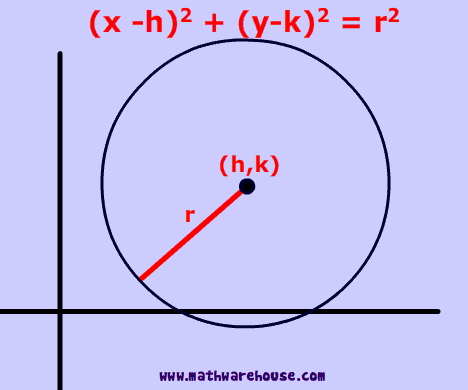
Standar form of the Equation of a circle

P.2 Graphs of Equation

then plug in points

P.3 Line in the Plane


if the dinaminator is 0 the slope is undifine
if the numerator is zero the slope is 0

point slope form:

P.4 Solving Equation Algebraically and Graphically

solve for:
solution:
The LCD is:

Multiply by the LCD and simplyfy


Point (a,0) is the x-intercept

Polynomial Equations
Degree:                         Name:                
1st                                Linear                  
2nd                              Quadratic
3rd                               Cubic
4th                               Quartic
5th                               Quintic

Solving Inequality

Linear:

Polynomial:

Thursday, November 15, 2012

Graphs of Secant, Cosecant, Tangent, and Cotangent


Tangent Function: y = tan x

  • One cycle occurs between -p/2 and p/2
  • There are vertical asymptotes at each end of the cycle
The asymptote that occurs at p/2 repeats every p units
  • Period = p
  • Amplitude = none, graphs go on forever in vertical directions


Cotangent Function: y = cot x
  • One cycle occurs between 0 and p
  • There are vertical asymptotes at each end of the cycle
The asymptote that occurs at p repeats every p units
  • Period = p
  • Amplitude = none, graphs go on forever in vertical directions


Cosecant Function: y = csc x
  • There are vertical asymptotes.  The asymptote that occurs at p repeats every p units.
  • Period = 2p
  •  Amplitude:  none, graphs go on forever in vertical directions.
  • The maximum values of y = sin x are minimum values of the positive sections of y = csc x.  The minimum values of y = sin x are the maximum values of the negative sections of y = csc x.
  • The x-intercepts of y = sin x are the asymptotes for y = csc x.


Secant Function: y = sec x
  • There are vertical asymptotes.  The asymptote that occurs at repeats every p units.
  • Period = 2p
  • Amplitude:  none, graphs go on forever in vertical directions.
  • The maximum values of y = cos x are minimum values of the positive sections of y = sec x.  The minimum values of
    y = cos x are the maximum values of the negative sections of
    y = sec x.
  • The x-intercepts of y = cos x are the asymptotes for 
    y = sec x.


Here are some helpful videos you might want to watch:


Graphs Of Sine and Cosine Functions

Graphs of Sine and Cosine Functions
Y=cos x
Y=sin x


The following two equations:

Y=d+a sin(bx-c)
And
Y=d+a cos(bx-c)
can experience various transformations as the functions change.

Amplitude
The amplitude of y= a sin x and y= a cos x respresents half of the distance between the max and min values and the equation below can be used:

Amplitude= IaI , where the absolute value of a is taken.

Increasing or decreasing the value of a will either vertically shrink or stretch the graph.

Example #1:
Consider the values:
Y=sin x
Y=2sin x
Y=1/2sin x


Y=cos x
Y=2cos x
Y=1/2cos x


Period
The period of a function of y=a sin bx and y= a cos bx can be found by the equations:

Period= 2 /b

Examples:


Shifting of Sine and Cosine graphs


Below you can see both the original graph of y =sin(x) and the graph of the translation

y = sin(x) + 1


y = (1/2)Cos 3x
Identify each before you graph:

Amplitude = 1/2
Period = 2
p/ 3
Maximums  are at the beginning point  (0, 1/2) and
End point (2
p/ 3, 1/2)
minimum point at (
p/3, -1/2)
Zeros at (
p/ 6, 0)  and ( p/ 2, 0)

y = -2 Sin (p/2)x

 Amplitude = | -2 | = 2
Period = 2p/ (p/ 2) = 4
Note that this graph is a reflection about the x-axis.  This interchanges the maximum and minimum values.
                        zeros : (0, 0), ( 2, 0), ( 4, 0)
                        minimum :( 1, -2)
                        maximum : ( 3, 2)


Thursday, November 1, 2012

fundamental identities


Fundamental Identities


You can use SOH CAH TOA if you forget these.
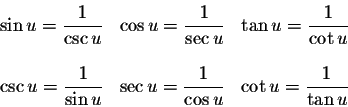
It is also important to know that cosecant is the reciprocal of sine,
Cotangent is the reciprocal of tangent
and Secant is the reciprocal of Cosine.


sin θ=oppositehypotenuse cos θ=adjacenthypotenuse tan θ=oppositeadjacent

-Identity is just another word for equivalence, and identities can be used to solve more complex identities and equations.
-To find the trigonometric functions for a given acute angle (theta), you can draw a right triangle that has theta as one of its angles.


Special Angles


**sin30=1/2=cos60.  This is because 30 and 60 are complementary angles and conjunctions of complementary angles are equal.


there are many groups of trigonometric identities, the first is the reciprocal identity.


displaymath161


the next group is the quotient identity.

displaymath163


there is also the pythagorean identity

displaymath162


In order to Prove the identity, here are some steps you can follow:
1. simplify the more complicated side until it is the same as the other side
2. Try to evaluate the identity in terms of sine and cosine.
3. Use the pythagorean identity as much as you can
4. Use factoring and combining of like terms


some examples include:

verify that:


verify that:


Functions on the XY plane


math expression


Standard position:

sin θ=yr cos θ=xr tan θ=yx


For further help, watch these videos!